
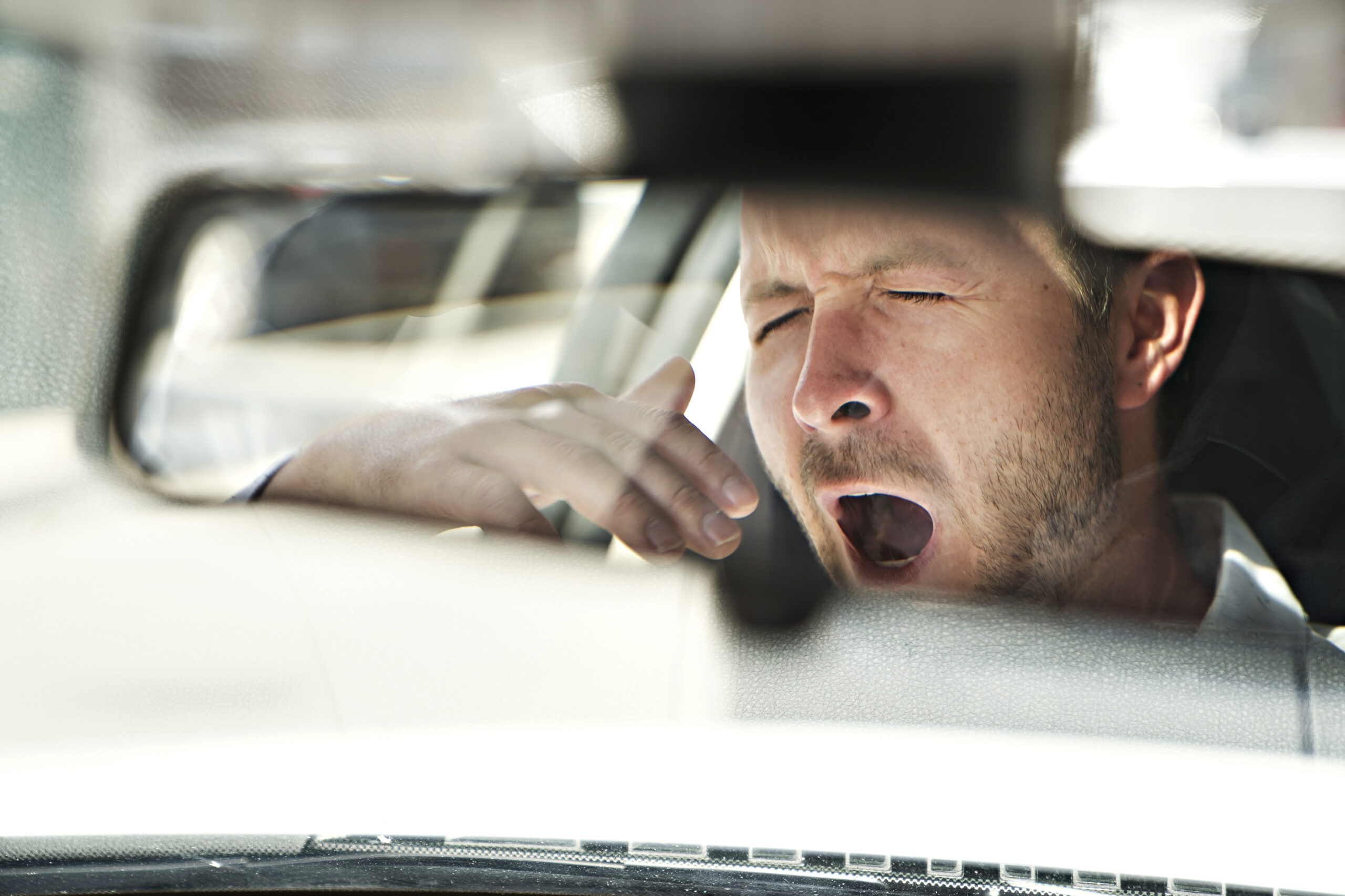
Most drivers have felt it – the heavy eyelids, the drifting thoughts, the jolt of awareness after a second or two of inattention. The difference between recognizing that feeling and pulling over versus pushing through can mean the difference between getting home safely and destroying someone else’s life. When a fatigued driver chooses to stay on the road and causes a crash, Pennsylvania law holds them accountable for that choice. If you were injured by a drowsy driver in Lancaster, York, or Chester County, here is what you need to know about your rights and your options.
How Dangerous Is Drowsy Driving?
Drowsy driving is consistently underestimated because, unlike alcohol or texting, there is no obvious signal that a driver is impaired. But the science is unambiguous: fatigue affects the brain in ways that closely mirror intoxication.
Research cited by the National Sleep Foundation shows that driving after being awake for 18 hours produces impairment equivalent to a blood alcohol content of 0.05%. Staying awake for 21 hours – a single all-nighter – produces impairment equivalent to a BAC of 0.08%, which is above the legal limit for driving in Pennsylvania. A driver who worked a double shift and got behind the wheel on the way home may be just as dangerous as a drunk driver, even though they passed no sobriety checkpoint.
Nationally, the NHTSA estimates drowsy driving is a factor in roughly one in six fatal crashes. In Pennsylvania, PennDOT recorded 2,509 crashes officially attributed to driver drowsiness or fatigue in a single recent year, including 12 fatalities – and PennDOT itself acknowledges that the true number is significantly higher, since drowsy driving is only counted when a driver clearly exhibits fatigue at the scene. Many crashes attributed to lane departure, failure to brake, or loss of control are often fatigue related.
The physical signature of a drowsy driving crash is distinctive:
- The vehicle drifts gradually out of its lane rather than swerving suddenly
- There are no skid marks – the driver never applied the brakes before impact
- The crash happens on a rural highway or monotonous stretch of road
- The time of crash is between midnight and 6:00 a.m., or in the mid-afternoon when the body’s circadian rhythm naturally dips
- The at-fault driver has no memory of the moments before impact
These patterns are the first things an experienced attorney looks for when evaluating whether a crash was caused by fatigue.
Who Is Most at Risk of Causing a Drowsy Driving Crash?
Anyone can drive while fatigued, but certain groups are statistically more likely to cause these accidents:
Commercial Truck Drivers
Federal Hours of Service regulations under 49 CFR Part 395 govern how long commercial drivers can operate before mandatory rest periods. A truck driver who violates logbook rules and drives beyond legal limits is not just breaking federal law – they are creating a foreseeable risk of a catastrophic crash. Trucking companies that pressure drivers to meet unrealistic delivery timelines share liability when those violations cause injury. When we handle commercial vehicle accidents involving fatigue, one of the first things we request is the driver’s electronic logging device data and the carrier’s dispatch records.
Shift Workers and Night Shift Employees
Nurses, factory workers, emergency responders, and others who work overnight shifts or rotating schedules face significantly elevated crash risk on their drives home. Studies show night shift workers may be up to six times more likely to have a fatigue-related crash. Lancaster, York, and Chester County’s manufacturing and healthcare sectors employ a large number of shift workers, which means these crashes happen locally with regularity.
Young Drivers
Drivers aged 16 to 29 – particularly young men – are disproportionately involved in drowsy driving crashes. Teenagers need more sleep than adults but typically get less, and their inexperience behind the wheel compounds the impairment that comes with fatigue.
Drivers With Untreated Sleep Disorders
Sleep apnea, narcolepsy, and other conditions can cause sudden episodes of extreme sleepiness even when a driver believes they are alert. Drivers with known, untreated sleep disorders who get behind the wheel may face enhanced negligence liability, particularly if their condition has previously caused near-miss incidents.
Long-Distance Travelers and Rideshare Drivers
Anyone driving extended distances without adequate breaks is at risk. Rideshare drivers, in particular, may drive for many continuous hours across multiple app sessions without the federal oversight that governs commercial truckers.
The Hardest Part: Proving Drowsy Driving in Pennsylvania
Unlike drunk driving – where a blood alcohol test produces an objective, admissible number – there is no breathalyzer for fatigue. This is the central challenge in these cases, and it is where the difference between an experienced attorney and a generalist becomes most apparent.
Drowsy driving is proven through layered circumstantial evidence. An attorney handling these cases will investigate:
- Police report details: officers note whether the vehicle showed lane drift, absence of braking, and the driver’s demeanor at the scene. Bloodshot eyes, slurred speech, or an admission of tiredness are documented.
- The driver’s schedule: work records, time-clock data, delivery logs, or trucking logbooks establish how long the driver had been awake and when they last slept.
- Electronic logging device (ELD) data: required for most commercial vehicles, these devices record driving hours with precision and cannot be falsified as easily as paper logs.
- Cell phone records: a driver who was active on their phone for hours before the crash, with no gap suggesting sleep, establishes a timeline of wakefulness.
- Medical records: a history of sleep apnea, sedating medications, or a prior sleep-related crash is powerful evidence of both the driver’s condition and their awareness of it.
- Witness statements: other drivers or passengers who observed the vehicle drifting, saw the driver nodding, or heard the driver admit exhaustion after the crash.
- Crash reconstruction: the absence of pre-impact braking and the direction of drift are measurable physical facts that an accident reconstruction expert can use to confirm fatigue as the cause.
- Dashcam and surveillance footage: increasingly common on Lancaster, York, and Chester County roads and from nearby businesses, footage of the vehicle’s behavior in the minutes before impact can be decisive.
Building this case takes investigation that begins immediately after the crash. Evidence disappears. Logbooks get altered. Surveillance footage is overwritten within days. The sooner a lawyer is involved, the stronger the case.
Pennsylvania Law and Drowsy Driving Liability
Pennsylvania does not have a specific criminal statute targeting drowsy driving the way it targets drunk driving – and the civil penalty for causing a fatal drowsy driving crash is, disturbingly, as low as a $500 fine in some cases. That disparity reflects how underserved victims of these crashes are by the criminal system, which is exactly why civil claims matter so much.
In a personal injury claim, the legal theory is negligence. A driver who operates a vehicle in a state of fatigue they knew or should have known was dangerous has breached the duty of care they owe to other road users. That breach, if it causes injury, creates liability for all resulting damages.
Pennsylvania’s modified comparative negligence rule under 42 Pa. C.S. § 7102 applies here as it does in all car accident cases. If an insurer argues that you were partly at fault – perhaps because you were speeding or failed to take evasive action – your recovery is reduced by your percentage of fault, as long as your share does not exceed 50%. Insurance companies raise comparative fault arguments routinely in drowsy driving cases, because fatigue is harder to prove and juries sometimes assign partial blame to the victim when causation is contested.
The two-year statute of limitations under 42 Pa. C.S. § 5524 applies to personal injury claims in Pennsylvania. Missing that deadline means losing the right to sue entirely – regardless of how strong the underlying case is.
What Compensation Can You Recover?
If you were injured by a drowsy or fatigued driver in Pennsylvania, you may be entitled to recover:
Economic Damages
- Past and future medical expenses – emergency care, hospitalization, surgery, rehabilitation, ongoing treatment
- Lost wages – income you were unable to earn during recovery
- Lost earning capacity – if your injuries affect your ability to work long-term
- Vehicle repair or replacement
- Out-of-pocket expenses related to the crash
Non-Economic Damages
- Pain and suffering
- Emotional distress and anxiety – including trauma symptoms that are common after violent crashes
- Loss of enjoyment of life
- Loss of consortium
Pennsylvania does not cap non-economic damages in standard personal injury cases. There are also situations where punitive damages may also be available, involving both commercial vehicles and standard passenger vehicles – these are damages awarded to the victim to punish reckless conduct and deter it going forward.
What to Do After a Drowsy Driving Crash
The steps you take in the immediate aftermath of a drowsy driving crash directly affect your ability to recover full compensation.
- Call 911: make sure a police report is filed. Ask the responding officer to note any signs of fatigue in the driver.
- Document the scene: photograph road marks (or the absence of them), vehicle positions, and any visible signs of lane drift.
- Talk to witnesses: get contact information from anyone who saw the crash or the other vehicle’s behavior beforehand.
- Seek medical attention immediately: fatigue-related crashes are often high-speed and cause serious injury. Internal injuries, traumatic brain injuries, and spinal injuries may not produce obvious symptoms immediately.
- Do not give a recorded statement to the other driver’s insurer: adjusters will use anything you say to reduce or deny your claim.
- Contact a personal injury attorney as early as possible: the preservation of ELD data, logbooks, surveillance footage, and other time-sensitive evidence must begin immediately.
How GLS Injury Law Handles Drowsy Driving Cases
Fatigued driving cases are among the most evidence-intensive car accident claims we handle at GLS Injury Law. The challenge of proving what the driver’s condition was at the moment of impact – without a test or an admission – requires early, aggressive investigation.
When a client comes to us after a crash that shows the hallmarks of drowsy driving – no skid marks, a gradual drift, an at-fault driver who has no clear explanation for what happened – we move immediately on the evidence that disappears first. We send preservation letters for ELD data and logbooks. We subpoena work and dispatch records. We identify and interview witnesses before their memories fade. We work with accident reconstruction experts who can translate the physical evidence into a clear account of what occurred.
We know how insurers and defense attorneys argue these cases in Lancaster, York, and Chester County courts. And we know how to counter those arguments. We handle every case on a contingency fee basis, meaning you pay nothing unless we recover compensation for you.
References:
- PennDOT Crash Statistics Dashboard: https://crashinfo.penndot.pa.gov/PCIT/welcome.html
- NHTSA Drowsy Driving: https://www.nhtsa.gov/risky-driving/drowsy-driving
- 49 CFR Part 395 (Federal Hours of Service): https://www.ecfr.gov/current/title-49/part-395
Frequently Asked Questions
Drowsy driving is proven through circumstantial evidence – the physical characteristics of the crash, the driver’s work schedule and logbook records, ELD data, cell phone records, witness statements, and expert reconstruction of the accident scene. No single piece of evidence is required; a strong case is built from multiple sources that together tell a compelling and consistent story about the driver’s condition.
Criminally, no – Pennsylvania does not have a specific drowsy driving statute, and the criminal penalties for causing a fatal drowsy driving crash are far lower than those for drunk driving. Civilly, however, a fatigued driver who causes injury can be held fully liable for all resulting damages under the same negligence standard that applies to any car accident case.
Commercial truck drivers are subject to federal Hours of Service regulations that limit how long they can drive without rest. A trucker who violates those regulations and causes a crash has both broken federal law and created clear evidence of negligence. In serious cases involving HOS or other violations of the Federal Motor Carrier Regulations, punitive damages may be available in addition to compensatory damages. The trucking company may also share liability if it enabled the driver to violate safety rules.
Pennsylvania’s statute of limitations for personal injury claims is two years from the date of the accident under 42 Pa. C.S. § 5524. However, the investigation into a drowsy driving crash should begin as quickly as possible – electronic logging data, surveillance footage, and other critical evidence may not be preserved for the full two-year window. Do not wait to contact an attorney.
Pennsylvania follows a modified comparative negligence rule under 42 Pa. C.S. § 7102. You can still recover compensation as long as your share of fault does not exceed 50%. Your recovery is reduced by your percentage of fault – so if you were found 15% at fault on a $200,000 case, you would recover $170,000. Insurance companies routinely argue comparative fault in drowsy driving cases to reduce payouts. An experienced attorney knows how to push back.
Settlement value depends on injury severity, the strength of the liability evidence, available insurance coverage, and whether a commercial carrier is involved. Serious injury cases involving commercial vehicle governing violations can produce significant recoveries – particularly when punitive damages are available. The best way to understand what your specific case is worth is to speak with an attorney who can review the facts directly.