

It happens in an instant. You are walking down a sidewalk you have walked a hundred times; your toe catches the raised edge of a slab that tree roots have pushed up, and suddenly you are on the ground — a broken wrist, a shattered hip, or worse. As the pain sets in, so does the question: was that my fault, or should someone have fixed that sidewalk? In Pennsylvania, the answer is often that someone should have, and that someone may owe you compensation.
But sidewalk cases are among the most legally complicated premises liability claims in Pennsylvania. The answer to “Can I sue?” depends on where you fell, who owns and controls the property the sidewalk abuts, whether a government entity is involved, what caused the defect, and critically, whether you act within a deadline that can be as short as six months. This guide explains who is responsible for a dangerous sidewalk in Pennsylvania, what legally counts as a sidewalk defect, how to prove your case, and the deadlines that can end a claim before it begins. At GLS Injury Law, our attorneys have recovered more than $120,000,000 for injured clients across Lancaster, York, and Chester County, including millions of dollars for those injured due to uneven sidewalks.
The Short Answer: Yes, You Often Can Sue For A Sidewalk Defect — But Against Whom Matters
Pennsylvania law gives injured pedestrians a real path to compensation when a dangerous sidewalk causes a fall. The claim is a premises liability action, and it rests on a straightforward principle: those who own and control property have a duty to keep the sidewalks abutting that property in reasonably safe condition for the people who use them. When they fail in that duty and someone is hurt, they can be held financially responsible.
The complication is not whether you can sue… it is identifying who is responsible. A sidewalk fall can implicate the abutting property owner, a commercial tenant, a landlord, a utility, or contractor whose work created the hazard, or the municipality itself. Often more than one party shares responsibility. Identifying every potentially liable party early is the single most important step in a sidewalk case because each comes with different rules, different insurance, and different deadlines.
Who Is Responsible for a Dangerous Sidewalk in Pennsylvania?
Pennsylvania follows the general rule that the property owner whose land abuts the sidewalk bears primary responsibility for maintaining it. But “abutting owner” is only the starting point. Responsibility can rest with several different parties depending on the circumstances.
The Abutting Property Owner
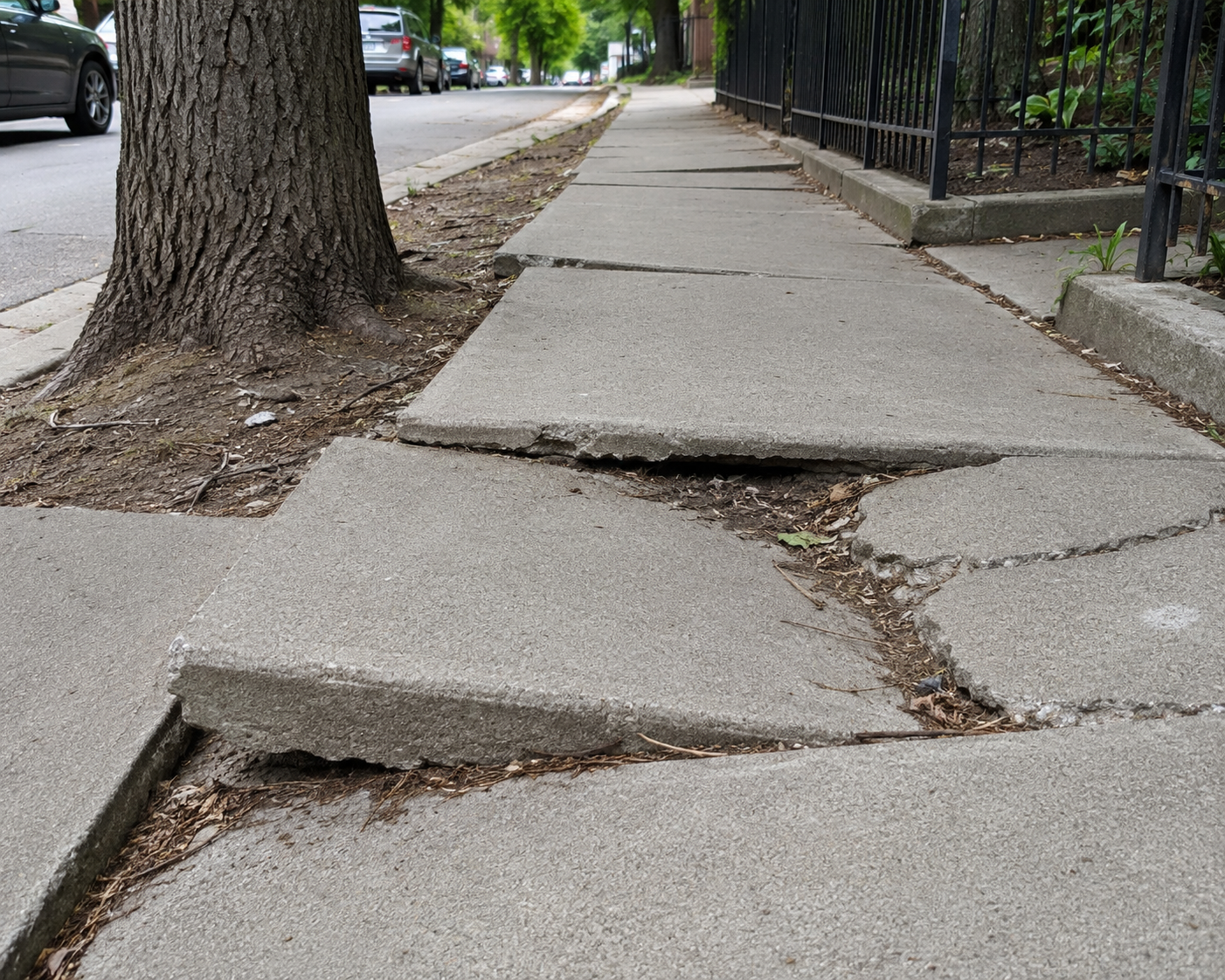
In most Pennsylvania municipalities, the owner of the property next to the sidewalk, not the city, is primarily responsible for keeping that sidewalk in good condition. This applies to residential homeowners and commercial property owners alike. If the owner knew or should have known about a dangerous condition such as a cracked slab, a section heaved by tree roots, or a crumbling edge, and failed to repair it within a reasonable time, they can be held liable for the resulting injuries. This duty exists because local ordinances across Pennsylvania place the obligation to maintain and repair sidewalks on the abutting landowner.
Commercial Property Owners and Tenants
Commercial property owners carry the same duty to maintain abutting sidewalks, and in practice, the expectations are often higher because businesses invite the public onto and past their premises. Where a commercial space is leased, the question of who is responsible — owner or tenant — often depends on the lease and on who actually controlled and maintained the sidewalk. Control matters more than title: a business that regularly cleared, repaired, or used the sidewalk for customer access may bear responsibility even if it does not own the land.
Landlords
For rental properties, responsibility for an abutting sidewalk generally remains with the landlord or property owner rather than the tenant, particularly for structural defects and common areas. Lease terms and the degree of control each party exercised shape the analysis.
Utility Companies and Contractors
Sometimes the dangerous condition was created by someone other than the property owner. A utility company that cut into a sidewalk to access lines and patched it poorly, or a contractor whose excavation left an uneven or sunken surface, can be directly liable for the hazard they created. These third-party defendants are easy to overlook and often carry substantial insurance.
The Municipality
A city, borough, or township can be liable for a sidewalk fall, but municipal claims are governed by special rules. Under Pennsylvania’s Political Subdivision Tort Claims Act, 42 Pa. C.S. § 8542(b)(7), a local agency can be held liable for “a dangerous condition of sidewalks within the rights-of-way of streets owned by the local agency,” but only if the injured person proves the dangerous condition created a reasonably foreseeable risk of the kind of injury that occurred and that the agency had actual or constructive notice of the condition far enough in advance to have fixed it. Importantly, the statute makes the municipality only secondarily liable in many cases, notable exceptions being that the sidewalk is adjacent to public property or a building owned by the government. The abutting owner remains primarily liable, which is one more reason every responsible party must be identified.
What Legally Counts as a “Sidewalk Defect” in Pennsylvania?
Not every imperfection in a sidewalk supports a lawsuit. Pennsylvania courts distinguish between actionable defects, which are conditions dangerous enough to create liability, and trivial irregularities that do not. The line is not a precise measurement, but the following conditions commonly support a claim:
- Height differentials between slabs. When one section of sidewalk has risen or sunk relative to the adjacent section, creating a lip or ledge that catches a pedestrian’s foot. Tree-root heaving is a frequent cause.
- Cracks, gaps, and holes. Wide cracks, separations between slabs, missing chunks of concrete, and holes large enough to catch a foot or turn an ankle.
- Crumbling or deteriorated concrete. Surfaces that have eroded, spalled, or broken apart over time through neglect.
- Improperly maintained curb cuts and ramps. Defective ADA ramps, broken curb transitions, and poorly graded cuts.
- Sunken or depressed sections. Areas that have settled, often near utility work or drainage problems, creating both a tripping hazard and a place for water to pool and freeze.
- Defective drainage causing ice. Where poor drainage allows water to collect and freeze, the resulting ice may be tied to an underlying structural defect rather than mere weather.
- Obstructions and debris. Materials, equipment, or overgrowth left to block or narrow the walkway.
The “trivial defect” doctrine allows defendants to argue that a minor, obvious irregularity was too small to be actionable. Whether a given defect is trivial or dangerous is intensely fact-specific. It depends on the size of the height differential, the location, lighting, foot traffic, and whether the condition was hidden or obvious. This is exactly the kind of dispute where measurements, photographs, and experienced legal judgment decide the outcome.
Snow and Ice: The Hills and Ridges Doctrine
Sidewalk falls caused by snow and ice are governed by a distinct Pennsylvania rule called the “hills and ridges” doctrine. Pennsylvania does not require property owners to keep sidewalks perfectly clear of snow and ice at all times — that would be impossible given the climate. Instead, the doctrine sets a specific standard, established by the Pennsylvania Supreme Court in Rinaldi v. Levine, 176 A.2d 623 (Pa. 1962).
Under the hills and ridges doctrine, an injured pedestrian must prove three things:
- Snow and ice accumulated in ridges or elevations of such size and character that they unreasonably obstructed travel and created a danger to pedestrians, not merely a generally slippery surface.
- The property owner had actual or constructive notice of the dangerous accumulation.
- The dangerous accumulation was what actually caused the fall.
Two important limits make the doctrine a double-edged sword. First, it only applies when generally slippery conditions prevailed in the community. A single isolated icy patch when streets were otherwise clear is not protected by the doctrine, which can favor the injured person. Second, the doctrine does not apply where the ice formed because of the owner’s own antecedent negligence – a defective drainage pipe, a downspout discharging across the walkway, taking on snow/ice removal but making the condition worse, only partially remediating the natural hazard and the traveler relying upon these efforts in traversing the area, or improper salting that created an unnatural accumulation. In those cases, the underlying defect, not the weather, is the cause. A Lancaster-area example illustrating the doctrine, Morin v. Traveler’s Rest Motel, Inc., 704 A.2d 1085 (Pa. Super. 1997), found generally slippery conditions across the area and applied the doctrine.
How to Prove a Pennsylvania Sidewalk Fall Case
Winning a sidewalk case requires proving the familiar four elements of negligence: that the responsible party owed you a duty, breached it, that the breach caused your fall, and that you suffered damages. In practice, the case is built on evidence, and sidewalk evidence disappears quickly. The strongest cases include:
- Photographs of the defect taken as soon as possible, ideally with a measurement reference (a coin, a ruler, or a shoe) showing the height differential or gap size before anyone repairs it.
- The precise location should be documented carefully. A vague description of “near the corner” can sink a case once the evidence is gone.
- Medical records connecting your injuries to the fall, beginning with prompt treatment on the day of the incident.
- Witness statements from anyone who saw the fall or who can attest the defect existed and how long it had been there.
- Evidence of notice — prior complaints, work orders, 311 reports, Google Street View history, or proof the condition existed long enough that the responsible party should have known.
- Incident documentation if you fell on commercial or government property and a report was made.
Constructive notice, proving the defect existed long enough that a reasonable owner should have discovered and fixed it, is frequently the deciding issue. Establishing how long a crack or height differential had been present can require historical photographs, maintenance records, and sometimes expert testimony.
The Deadline That Can End Your Case: Notice and the Statute of Limitations
Two separate clocks run on a Pennsylvania sidewalk case and missing either one can permanently bar recovery.
- The two-year statute of limitations. Under 42 Pa. C.S. § 5524, most Pennsylvania personal injury claims — including sidewalk falls against private owners — must be filed within two years of the date of injury.
- The six-month government notice requirement. If a municipality or other government entity may be responsible, 42 Pa. C.S. § 5522 requires written notice of the claim to the government agency within six months of the injury. Miss that window, and the claim against the government can be lost, even though the two-year statute has not yet run.
Because it is not always obvious at the outset whether a government entity may share responsibility, the safest course is to treat every sidewalk fall as potentially involving the shorter six-month deadline and to consult an attorney quickly. There are also damages caps and special proof requirements in claims against government entities that an experienced attorney will navigate.
What Compensation Can You Recover?
Sidewalk falls produce some of the most serious injuries in Pennsylvania premises liability claims. A hard concrete landing can fracture a hip, wrist, or ankle, herniate a disc, or cause a traumatic brain injury. A back or spine injury from a fall can require surgery and produce permanent limitations. Recoverable damages in a successful claim include:
- Medical expenses, past and future, including surgery, rehabilitation, and ongoing care.
- Lost wages and lost earning capacity when injuries keep you from working.
- Pain and suffering for the physical pain and emotional toll of the injury.
- Permanent scarring or disfigurement, which Pennsylvania recognizes as a separately compensable category.
- Loss of life’s pleasures when injuries limit the activities you once enjoyed.
When a sidewalk fall causes a fatality, as catastrophic falls involving older adults sometimes do, surviving family members may pursue a wrongful death claim under Pennsylvania’s Wrongful Death Act and a Survival Act claim through the decedent’s estate.
What to Do After a Sidewalk Fall in Pennsylvania
The steps you take immediately after a fall can make or break a future claim. Our broader guide on slip, trip, and fall accidents covers the full checklist, but the essentials for a sidewalk fall are:
- Photograph the defect immediately, with a size reference, before it is repaired.
- Note the exact location using a building address, nearby landmark, or GPS pin.
- Seek medical attention the same day, both for your health and to document causation.
- Identify witnesses and collect their contact information.
- Report the fall to the property owner, business, or municipality, and keep a copy of any report.
- Do not give a recorded statement to an insurer before speaking with an attorney.
- Contact a lawyer quickly, especially given the possible six-month government notice deadline.
Frequently Asked Questions
Often, yes. If a cracked, heaved, or uneven sidewalk caused your fall and the responsible party (usually the abutting property owner) knew or should have known about the defect and failed to repair it within a reasonable time, you may have a premises liability claim. The key questions are who controlled the sidewalk, whether the defect was dangerous rather than trivial, and whether you act within the applicable deadline — which can be as short as six months if a government entity is involved.
In most Pennsylvania municipalities, the property owner whose land abuts the sidewalk is primarily responsible for maintaining it, because local ordinances place that duty on the abutting owner. A municipality can be liable under 42 Pa. C.S. § 8542(b)(7) for dangerous conditions of sidewalks within its street rights-of-way, but often only secondarily, with the abutting owner primarily liable. Utility companies and contractors can also be responsible if their work created the hazard. Identifying every responsible party early is essential.
Common actionable defects include height differentials between slabs (often from tree roots), wide cracks and gaps, missing or crumbling concrete, sunken sections, defective curb cuts, and drainage problems that create ice. Pennsylvania’s “trivial defect” doctrine lets defendants argue a minor irregularity was too small to be actionable, so whether a defect is dangerous or trivial is fact-specific — depending on the size of the differential, the location, lighting, and foot traffic. Photographs with a size reference are critical evidence.
Snow and ice falls are governed by Pennsylvania’s “hills and ridges” doctrine, established in Rinaldi v. Levine. You generally must show the snow or ice accumulated in ridges or elevations that unreasonably obstructed travel, that the owner had notice, and that this accumulation caused your fall. The doctrine does not apply, however, where the ice formed because of the owner’s own negligence — such as a defective downspout or drainage problem — or where conditions were not generally slippery throughout the community.
The general personal injury statute of limitations is two years from the date of the fall under 42 Pa. C.S. § 5524. But if a municipality or other government entity may be responsible, you must provide written notice within six months under 42 Pa. C.S. § 5522 — a much shorter deadline that catches many people off guard. Because government involvement is not always obvious at first, it is safest to consult an attorney quickly.
Nothing up front. We handle every premises liability case on a contingency fee basis — you pay no legal fees unless we recover compensation for you. The initial consultation is always free. We can meet at our office, your home, a hospital, or a rehab facility throughout Lancaster, York, and Chester County.