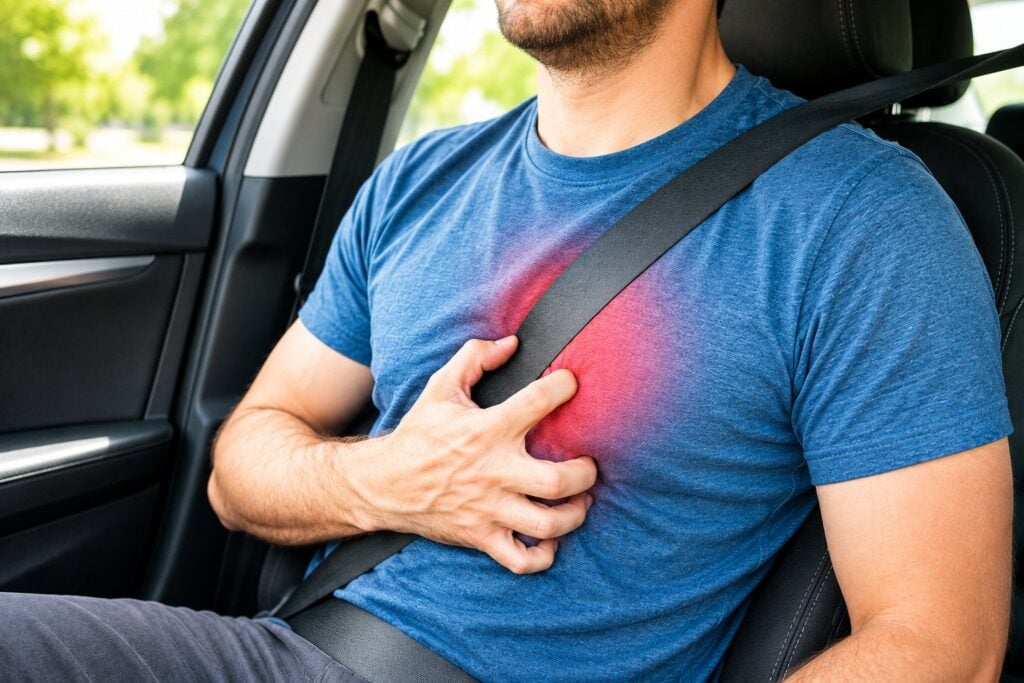


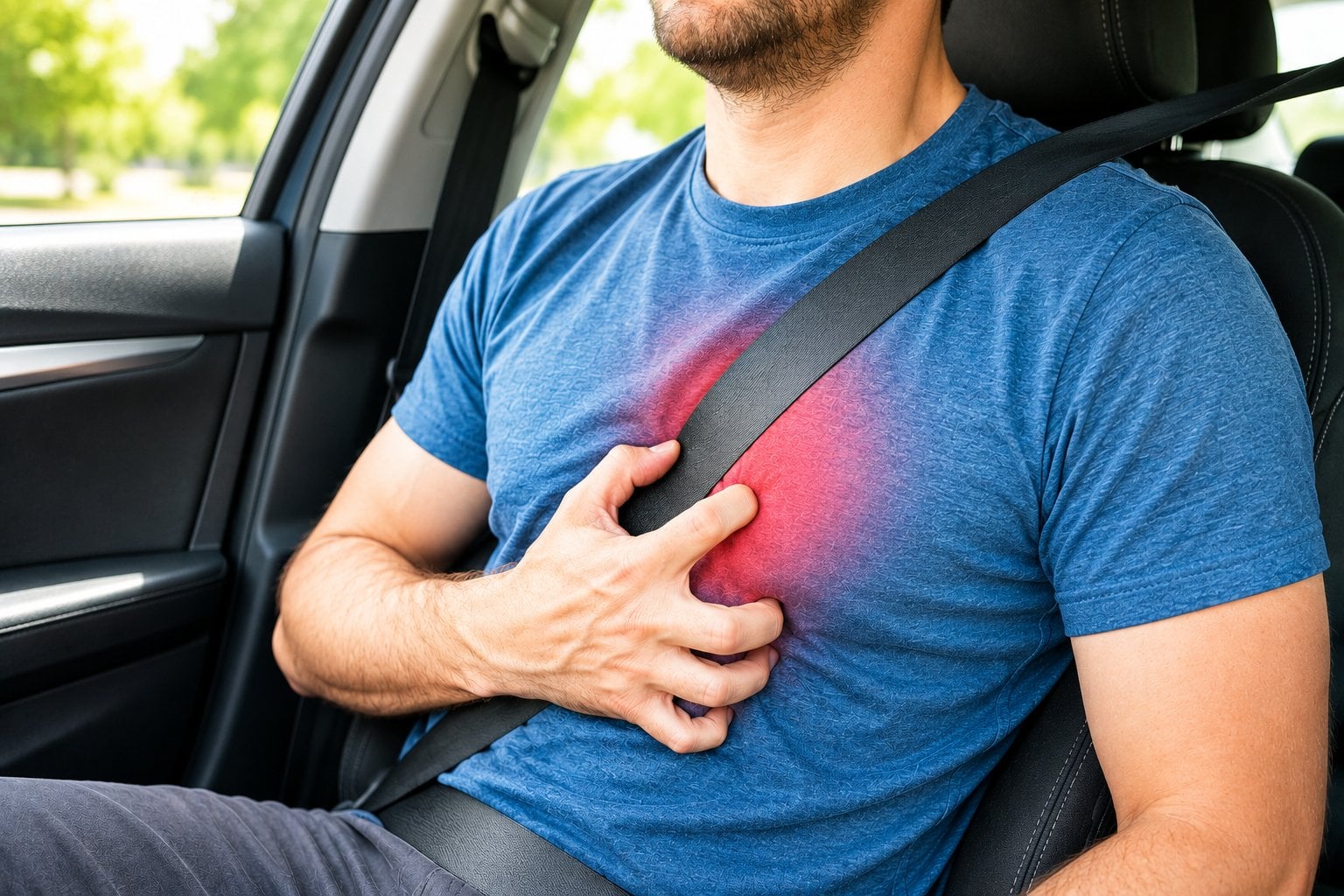
In the seconds after a car crash, adrenaline can hide a lot. But once it fades, many people notice a deep ache in the center of their chest — sharp when they breathe in, worse when they cough, laugh, or twist. Often, that pain traces back to the seat belt. The same belt that very likely saved your life can, in a hard enough impact, bruise or even fracture the sternum — the flat breastbone in the center of your chest.
If you are searching for answers about chest or sternum pain after a crash, this guide explains what these injuries are, how to tell a bruise from something more serious, the warning signs you should never ignore, and for Pennsylvania crash victims, what your legal rights are when someone else causes the collision. One thing first, and we will keep saying it because it matters: this article is general information, not medical advice, and chest injuries can be deceptively serious. If you have chest pain after a crash, get evaluated by a doctor.
Call 911 or Go to the ER Now If You Have Any of These:
Some chest injuries are life-threatening and need emergency care immediately. Do not wait to see if these pass:
- Difficulty breathing, shortness of breath, or breathing that is getting worse
- Chest pain that is severe, crushing, or spreading to the arm, neck, or jaw
- A fast, irregular, or pounding heartbeat, or feeling faint or passing out
- Coughing up blood
- A visible deformity of the chest, or a section of the chest that moves abnormally when you breathe
- Confusion, bluish lips or fingertips, or cold sweats
When in doubt, treat chest symptoms as an emergency. It is always better to be checked and cleared.
Why Seat Belts Cause Chest and Sternum Injuries
Let’s be clear up front: seat belts save lives. They are among the most effective safety devices ever invented and prevent far more severe injuries than they ever cause. The injuries described here are the price the belt sometimes exacts for keeping you inside the vehicle and away from the steering wheel, windshield, or worse. Wearing your seat belt is always the right choice.
That said, the physics of a crash are unforgiving. When a vehicle suddenly decelerates, your body keeps moving forward until the seat belt stops it. All that force concentrates along the belt’s path — diagonally across the chest and shoulder. In a significant impact, that force can be enough to bruise or break the sternum and the ribs beneath the belt. Doctors sometimes call the pattern of belt-related injuries “seat belt syndrome,” and a visible bruise or abrasion along the belt line is known as the “seat belt sign” — a marker that tells physicians to look carefully for deeper injury underneath.
Chest injuries can also come from the airbag striking the chest, from contact with the steering wheel or dashboard, or from the whipping motion of the crash straining the muscles and cartilage that anchor to the sternum. Often several of these forces combine.
Types of Sternum and Chest Injuries
“Chest injury” covers a wide range, from a painful bruise to a medical emergency. The most common after a crash include:
Bruised Sternum (Sternal Contusion)
A sternal contusion is a deep bruise to the breastbone and the surrounding soft tissue, without a break in the bone. It can still be very painful — the chest may be tender, swollen, and discolored, and Deep breathing, coughing, or movement can hurt. A bruised sternum often heals on its own over time. of weeks, but the symptoms overlap heavily with more serious injuries, which is why it should never be self-diagnosed.
Fractured (Cracked or Broken) Sternum
A sternal fracture is a crack or break in the breastbone. Because the sternum is a strong, flat bone, it usually takes significant force to fracture it — which is why a fractured sternum is a red flag for doctors that other, hidden injuries may be present. Symptoms include severe chest pain that worsens with breathing or movement, tenderness and swelling over the bone, and, in severe cases, a grinding or popping sensation or even a visible deformity. Fractures are confirmed with imaging such as an X-ray, CT, or MRI.
Rib Fractures and Flail Chest
The same forces that injure the sternum often fracture the ribs. When several adjacent ribs are broken in more than one place, a segment of the chest wall can become detached and move independently from the rest — a dangerous condition called flail chest that impairs breathing and requires emergency care. Notably, research shows that a meaningful share of rib fractures do not appear on an initial X-ray, underscoring why a thorough medical evaluation matters.
The Hidden Danger: Injuries Beneath the Sternum
This is what makes chest injuries genuinely dangerous rather than merely painful. The sternum sits directly over the heart and lungs. The force that bruises or fractures it can also injure what lies beneath, including a cardiac contusion (a bruised heart), a pulmonary contusion (a bruised lung), a punctured or collapsed lung, or internal bleeding. Lower or side-of-chest impacts can also injure the liver or spleen. These conditions can be life-threatening and are not always obvious from the outside — which is why a crash victim with chest pain needs a doctor to rule them out, not reassurance from an internet article.
Symptoms of a Sternum or Chest Injury
After a crash, watch your body closely in the hours and days that follow. Common symptoms of a sternum or chest injury include:
- Chest pain over the breastbone that worsens with deep breaths, coughing, sneezing, laughing, or twisting
- Tenderness, swelling, or bruising over the center of the chest, sometimes along the seat belt line
- Pain when moving the arms or when lying down in certain positions
- A cracking, popping, or grinding sensation in the chest
- Shortness of breath or shallow breathing because deep breaths hurt
- Pain that appears or worsens hours or days later — delayed symptoms are common and dangerous to ignore
When to See a Doctor — and Why You Should Never Self-Diagnose
The single most important message of this article: you cannot reliably tell the difference between a simple bruised sternum and a fracture, a cardiac contusion, or internal bleeding on your own. The symptoms overlap, and some of the most serious injuries reveal themselves slowly. A bruise and a life-threatening injury can feel remarkably similar in the first hours.
After any crash involving a chest impact, you should be evaluated by a medical professional promptly — even if you think you are “just bruised.” Seek emergency care immediately for any red flags. symptoms listed at the top of this article. And regardless of severity, follow up with a doctor if pain persists, worsens, or interferes with breathing. Prompt evaluation protects your health first — and, as a secondary benefit, creates the medical record that connects your injury to the crash if you later pursue a claim.
Recovery and Treatment
Treatment depends entirely on the injury and must be directed by your doctor, but in general, milder chest injuries, such as a bruised sternum, are often managed with rest, pain control, and time, with healing over a period of weeks. Fractures and injuries to the organs beneath the chest can require more intensive care, monitoring, and a longer recovery, sometimes months. Because the pain of a chest injury can make people breathe shallowly, doctors also watch for secondary complications like pneumonia. The key point for recovery is the same as everywhere else in this article: follow the treatment plan your physician gives you and keep your follow-up appointments.
Your Rights After a Pennsylvania Crash: The Seat Belt Cannot Be Used Against You
If someone else’s negligence caused your crash, that driver is responsible for the injuries the crash caused — including chest and sternum injuries caused by your seat belt doing its job. You should never let an insurance adjuster suggest that your injury is somehow your own fault because of how you were belted. When another driver’s carelessness caused the collision, a Pennsylvania car accident claim can pursue compensation for your medical bills, lost income, and pain and suffering.
Pennsylvania law provides a powerful and surprising protection on this point. Under 75 Pa. C.S. § 4581(e), evidence of whether a person was or was not wearing a seat belt is inadmissible in a civil injury trial. A jury cannot be told that non-use of a seat belt constitutes contributory negligence. In other words, the at-fault driver’s lawyer cannot argue to a jury that your injuries are your fault because of the seat belt — whether you were belted or not. The Pennsylvania Superior Court strictly enforced this rule in Gaudio v. Ford Motor Company, 976 A.2d 524 (Pa. Super. 2009), holding that the statute means what it says. Many out-of-state articles on chest injuries overlook this because their states allow a “seat belt defense” that Pennsylvania does not.
Adjusters sometimes still bluff, hinting that your belt use will reduce your claim, because they are counting on you not knowing the law. It is a bluff, and you do not have to accept it.
How Pennsylvania’s Other Rules Affect a Chest-Injury Claim
Two more Pennsylvania rules shape the value of a chest-injury claim. First, your comparative negligence share, if any, for causing the crash itself (not for seat belt use) can reduce your recovery, and being more than 50% at fault bars recovery. Second, whether you carry “full tort” or “limited tort” on your auto policy can affect your ability to recover for pain and suffering — though a serious injury like a sternum fracture may satisfy the limited-tort ‘serious injury’ threshold. Because these rules interact, it is wise to discuss your car accident case with an attorney before you accept any offer.
What to Do After a Chest Injury in a Pennsylvania Crash
Alongside the full steps to take after a car accident, these steps matter most for a chest injury:
- Get medical care immediately — health first. Be evaluated even if you feel only bruised, and go to the ER for any red-flag symptom. This is about your life, not your lawsuit.
- Describe every symptom to the doctor, including pain that comes and goes, so nothing is missed and everything is documented.
- Follow the treatment plan and keep every follow-up. Gaps in care hurt your recovery and can be used to dispute a claim.
- Keep records. Medical bills, imaging, time missed from work, and a simple journal of how the injury affects your daily life.
- Do not give a recorded statement or accept an early offer from the insurer before speaking with an attorney — chest injuries can have costs that appear later.
- Act within the deadline. Pennsylvania’s statute of limitations for most car accident claims is two years from the date of the crash.
Frequently Asked Questions
You often can’t tell on your own — the symptoms of a bruised sternum and a fractured sternum overlap heavily, and both can mask more serious injuries to the heart or lungs. Only a medical evaluation, usually including imaging like an X-ray or CT scan, can tell the difference reliably. Because a fractured sternum takes significant force and can signal hidden injuries, you should be evaluated promptly after any crash involving a chest impact rather than trying to self-diagnose.
It depends entirely on the injury and should be assessed by your doctor. In general terms, a bruised sternum often improves over a period of weeks, while a fracture or an injury to the organs beneath the chest can take longer and may require more intensive care. Your physician can give you a realistic timeline based on imaging and your specific injury.
Go to the ER or call 911 immediately if you have trouble breathing, severe or crushing chest pain, a fast or irregular heartbeat, fainting, coughing up blood, a visible chest deformity, or bluish lips — these can signal life-threatening injuries. More broadly, any significant chest pain after a crash warrants prompt medical evaluation, because some serious injuries develop or worsen over hours.
No. Under 75 Pa. C.S. § 4581(e), evidence of seat belt use or non-use is not admissible in a Pennsylvania civil injury trial, and a jury cannot be told it was contributory negligence. The at-fault driver remains responsible for the injuries the crash caused — including chest injuries caused by the seat belt. Adjusters sometimes bluff about this, but Pennsylvania courts enforce the rule strictly.
Yes. Seat belts save lives, and being injured by one does not reduce the at-fault driver’s responsibility. If another driver’s negligence caused the crash, that driver is liable for the injuries you suffered — including sternum, rib, and other chest injuries — along with your medical bills, lost wages, and pain and suffering.
Nothing. We handle car accident and personal injury cases on a contingency fee basis — you pay no legal fees unless we recover compensation for you. The consultation is always free, and we can meet at our office, your home, a hospital, or a rehab facility throughout Lancaster, York, and Chester County.