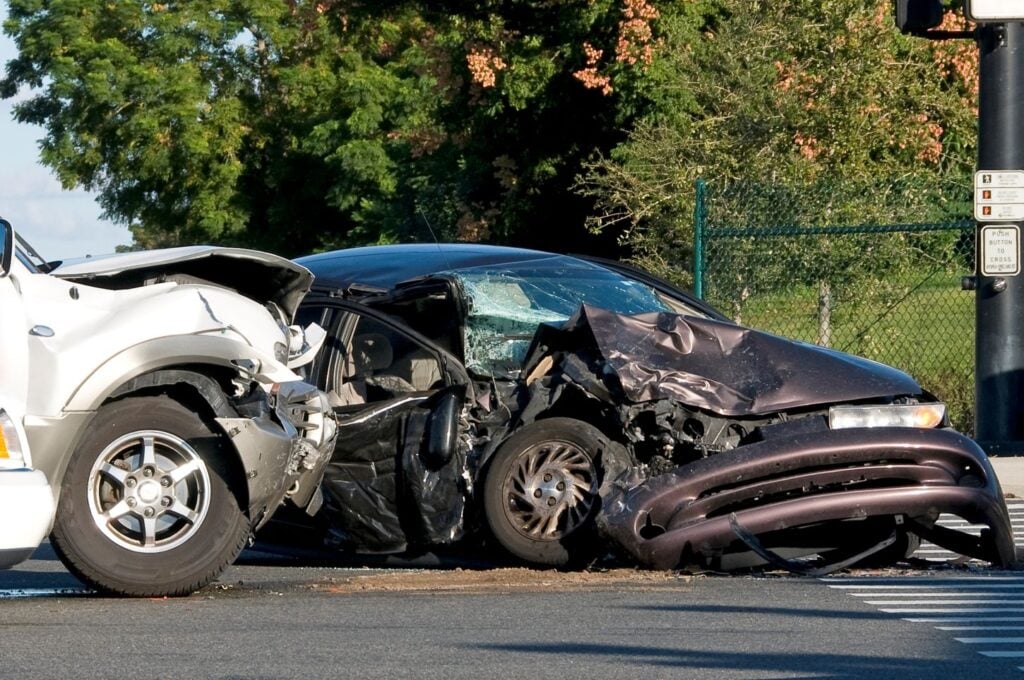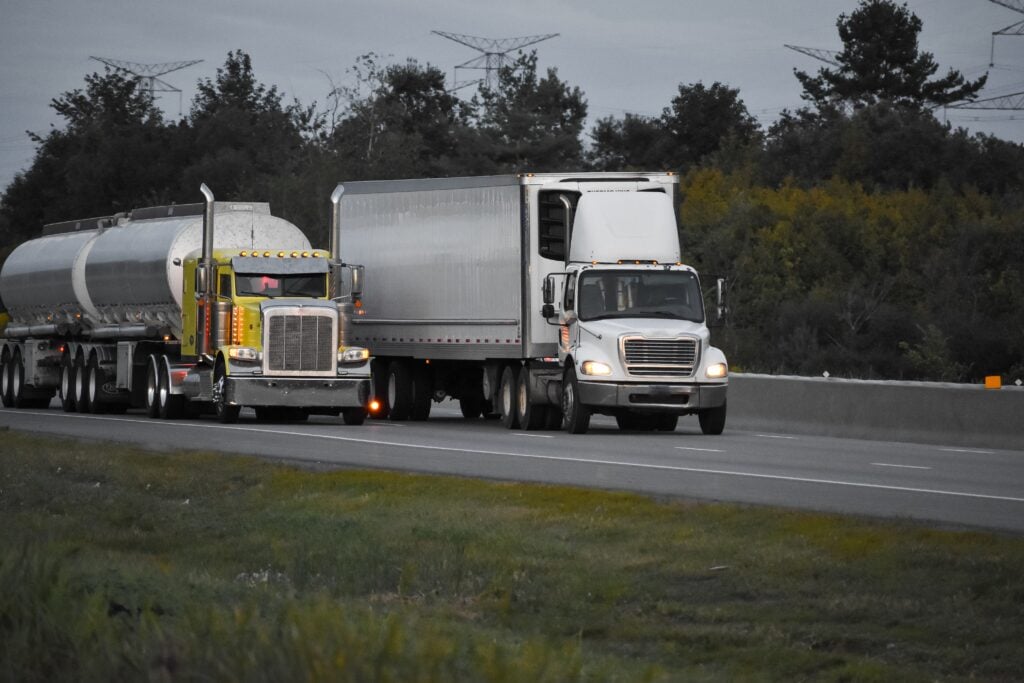



A fully loaded semi-truck can legally weigh up to 80,000 pounds — 40 tons — under federal and Pennsylvania law. Empty, a tractor and trailer together weigh roughly 30,000 to 35,000 pounds. For comparison, the average passenger car weighs about 4,000 pounds, which means a loaded tractor-trailer can outweigh the car it hits by 20 to 1.
People search this question for all kinds of reasons — curiosity, a CDL exam, a logistics job. But if you’re asking because a truck just hit you or someone you love, the weight isn’t trivia. It’s the single biggest reason truck crashes are so much deadlier than car crashes, and it’s a central piece of evidence in the claim that follows.
Semi-Truck Weight at a Glance
| Configuration | Approximate weight |
| Tractor (cab) only, empty | 15,000 – 25,000 lbs |
| 53-foot dry van trailer, empty | 10,000 – 15,000 lbs |
| Tractor + empty trailer | 30,000 – 35,000 lbs |
| Tractor + loaded trailer (legal max) | 80,000 lbs |
| Typical passenger car | About 4,000 lbs |
| Large SUV or pickup | 5,000 – 7,000 lbs |
These figures explain the common nicknames: an “18-wheeler” is simply a standard tractor-trailer with eighteen wheels across five axles, and a “semi” refers to the semi-trailer, which has no front axle of its own and rests on the tractor.
Where the 80,000-Pound Limit Comes From
The federal limit on interstate highways is set by law: 80,000 pounds gross vehicle weight, with no more than 20,000 pounds on a single axle and 34,000 pounds on a tandem (two-axle group). A “bridge formula” further limits weight based on how far apart the axles are, to protect bridges and pavement. Pennsylvania adopts the same ceilings for its own roads under the Vehicle Code, and the Pennsylvania State Police enforce them at weigh stations and with portable scales.
Heavier loads are possible only with a special permit for an oversize or overweight load, which typically comes with route restrictions, escorts, and time-of-day limits. Without a permit, anything over 80,000 pounds is illegal — and, as explained below, that illegality matters enormously in a crash case.
Truck Weight Classes: Where a Semi Fits
Trucks are sorted into federal classes by their Gross Vehicle Weight Rating (GVWR) — the maximum weight the manufacturer rates the vehicle to carry, including itself and its cargo:
| Class | GVWR | Examples |
| 1–3 (light duty) | Up to 14,000 lbs | Pickups, SUVs, cargo vans, small delivery vans |
| 4–6 (medium duty) | 14,001 – 26,000 lbs | Box trucks, large delivery trucks, school buses |
| 7 (heavy duty) | 26,001 – 33,000 lbs | Garbage trucks, furniture trucks, city transit buses |
| 8 (heavy duty) | 33,001 lbs and up | Semi-tractors, dump trucks, cement mixers |
A semi-tractor is a Class 8 vehicle. Class 7 and above require a commercial driver’s license — one reason the rules for who drives these trucks, and how long they can drive, are so much stricter than for a car.
Why Weight Makes Truck Crashes So Much Worse
The physics is unforgiving, and it comes down to two things: energy and stopping distance.
Kinetic energy: 20 times the mass, 20 times the energy
The energy a moving vehicle carries into a collision grows with its mass and with the square of its speed. At the same speed, a vehicle twenty times heavier carries twenty times the energy — and in a crash, most of that energy is absorbed by the lighter vehicle and the people inside it. This is why occupants of the passenger vehicle account for the overwhelming majority of deaths in truck-car collisions, while truck drivers often walk away.
Stopping distance: nearly double
Weight also governs how long a truck takes to stop. According to the Federal Motor Carrier Safety Administration, a fully loaded tractor-trailer traveling at 65 mph needs about 525 feet to come to a stop — nearly the length of two football fields, and roughly twice the distance a passenger car needs at the same speed. On a wet or icy Pennsylvania highway, those distances grow further; our guide to winter accidents with tractor-trailers explains why. The practical consequence: a loaded truck following too closely, or approaching slowed traffic too fast, physically cannot stop in time.
Height, underride, and rollover
Weight isn’t the only physics problem. A trailer’s bed sits roughly four feet off the ground, so in a collision a car can slide beneath it — an underride crash that bypasses the car’s crumple zones and airbags entirely. A high, heavy load also raises the truck’s center of gravity, making rollovers and jackknifes more likely in sudden maneuvers.
How Truck Weight Matters in a Pennsylvania Injury Claim
Beyond explaining the severity of the injuries, weight is evidence. In a truck accident claim, it can establish fault, reveal violations, and point to every party responsible.
Overloading is negligence — and often negligence per se
A truck over the 80,000-pound limit, or over its axle limits, is in violation of federal and Pennsylvania law. Because those laws exist to protect other motorists, violating them can support negligence per se, which establishes duty and breach without further argument. Overloaded trucks take longer to stop, blow tires, overheat brakes, and overturn — and the violation itself can shift liability to whoever loaded, dispatched, or operated the truck.
The weight evidence trail
Unlike a car, a commercial truck generates records of exactly how heavy it was and how it was being driven:
- Scale tickets and weigh-station records showing the actual weight on the day of the crash.
- Bills of lading and shipping documents listing the cargo and its declared weight.
- Electronic logging device (ELD) data recording hours of service — a tired driver in a heavy truck is a known, deadly combination.
- Engine control module (“black box”) data capturing speed, braking, and throttle in the seconds before impact.
- Inspection and maintenance records, including brakes rated for the loads actually carried.
- Cargo securement records — shifting or improperly secured loads are a frequent cause of rollovers.
Trucking companies and their insurers know this evidence exists and move quickly after a crash to control it. Some records can be lawfully overwritten within days or weeks unless a preservation demand is sent. That’s one reason our guide warns you to never talk to a trucking company’s insurance adjuster without an attorney — the first call after a crash is often an attempt to shape the record before the evidence is secured.
More weight, more parties, more insurance
The weight of a commercial truck is also why the law requires far more insurance behind it. Federal rules require most interstate carriers to carry at least $750,000 in liability coverage — and millions for hazardous materials — compared with Pennsylvania’s $15,000 minimum for a private car. And a heavy-truck crash often involves several liable parties: the driver, the carrier, the company that loaded the trailer, the shipper, a maintenance contractor, or a manufacturer. Identifying all of them is central to what a crash claim is worth, because the injuries a 40-ton vehicle causes routinely exceed any single policy.
Truck Crashes in Pennsylvania
Pennsylvania’s position at the crossroads of the Northeast — I-81, I-78, I-76, I-83, and Route 30 all carry heavy freight through our region — makes truck crashes a daily reality. The state has ranked among the top ten nationally for tractor-trailer accidents, as we detailed in our look at Pennsylvania’s tractor-trailer accident ranking. In 2025, PennDOT recorded 7,094 crashes involving a heavy truck statewide, and heavy-truck crashes account for a disproportionate share of serious injuries and deaths. Our look at the rising death rate in large-truck accidents explains the trend.
What to Do After a Crash With a Semi-Truck
- Get medical care immediately, even if you feel okay — the forces involved cause injuries that can surface later even if not immediately apparent.
- Call the police and make sure a report is filed; note the carrier name and DOT number on the truck.
- Photograph everything, including the truck, its cargo, skid marks, and the scene.
- Don’t give a recorded statement to the trucking company or its insurer. Trucking companies move fast after an accident, many times having their attorneys, safety personnel, or claims representatives show up at the accident scene or hospital.
- Contact an attorney fast. Preservation letters for ELD, black-box, and weight records need to go out within days.
- Check your own coverage. If the truck’s insurance is disputed or the injuries exceed it, your own policy may be an additional source of recovery.
On that last point: in most truck cases the carrier’s policy is the primary target, but your own uninsured and underinsured motorist coverage can matter when liability is contested or the damages are catastrophic.
Frequently Asked Questions
A tractor-trailer weighs roughly 30,000 to 35,000 pounds empty and up to 80,000 pounds fully loaded, which is the legal maximum under federal and Pennsylvania law without a special permit. The tractor alone weighs about 15,000 to 25,000 pounds, and an empty 53-foot trailer about 10,000 to 15,000 pounds.
Up to 80,000 pounds — 40 tons — on public roads without an overweight permit. Federal law also limits weight on each axle group: 20,000 pounds on a single axle and 34,000 pounds on a tandem. Permitted oversize/overweight loads can exceed these limits under strict conditions.
About 20 times as much. The average passenger car weighs around 4,000 pounds; a loaded semi can weigh 80,000. At the same speed, the truck carries roughly 20 times the energy into a collision, which is why occupants of the smaller vehicle suffer most of the injuries and deaths in truck-car crashes.
A fully loaded tractor-trailer at 65 mph needs about 525 feet to stop, according to the Federal Motor Carrier Safety Administration — nearly two football fields and roughly twice a passenger car’s stopping distance. Wet or icy roads, worn brakes, and overloading all increase it further.
Yes. Exceeding the legal weight limits violates federal and Pennsylvania law, which can establish negligence per se and shift liability to the carrier, loader, or shipper. Overloading also lengthens stopping distance and increases rollover and brake-failure risk. Scale tickets and bills of lading can prove the truck’s actual weight.
Several reasons: the injuries are usually far more severe, federal trucking regulations create additional duties and evidence, multiple parties (driver, carrier, loader, shipper, manufacturer) may be liable, the insurance policies are much larger, and critical evidence like electronic logs and black-box data can be lost within days without a preservation demand. An attorney experienced in truck cases moves on all of this immediately.