

Few things define a Pennsylvania summer like time at a pool. Backyard pools, neighborhood and community pools, hotel pools, and HOA pools fill up the moment temperatures climb. They are also among the most dangerous places a child can spend an afternoon. Drowning is the leading cause of unintentional injury death for children ages 1 to 4 in the United States, and the second-leading cause for ages 5 to 14. Roughly 4,000 fatal unintentional drownings occur each year, plus another 8,000 nonfatal drownings serious enough to require emergency care. The peak season runs May through August, the same months most Pennsylvania pools are open.
Most pool tragedies are preventable. Pennsylvania law imposes specific safety requirements on pool owners, and pool injury cases that reach attorneys are almost always rooted in a failure to follow those requirements. This guide explains how to prevent a swimming accident, what Pennsylvania law requires of pool owners and operators, and what your legal rights are if something goes wrong.
How Pool Accidents Happen — and Why Summer Increases the Risk
Summer compresses the year’s pool risk into a few short months. Schools are out, families travel to hotels with pools, backyard pools open for the season, and community pools see their highest attendance. Heat waves push usage even higher. With more swimmers, more young children, more guests, and more inattention, the rate of pool injuries climbs sharply between Memorial Day and Labor Day.
Pool accidents fall into a handful of recurring categories:
- Drowning and near-drowning: the most catastrophic category, often involving young children who reach a pool unsupervised through a gate left open, a fence too short or in disrepair, or an unsecured back door
- Diving injuries: spinal cord injuries from diving into water that is too shallow, into above-ground pools, or off poolside structures
- Slip-and-fall on pool decks: wet tile, missing slip-resistant surfacing, broken concrete, or unmarked elevation changes that produce fractures and head injuries
- Drain entrapment: hair, limbs, or swimsuits caught in defective or non-compliant drains, sometimes resulting in disembowelment, drowning, or death
- Chemical burns and toxic exposures: from improperly stored or mixed pool chemicals
- Electrical injuries: from faulty wiring of pool lights, pumps, or surrounding equipment
- Diving boards and slides: injuries from defective installation, missing handrails, or poor maintenance
- Lifeguard negligence: inadequate supervision, untrained staff, or distracted lifeguards at hotels, community pools, and waterparks
Drowning: The Numbers Every Parent Should Know
The Centers for Disease Control and Prevention (CDC) tracks drowning data closely:
- Drowning is the #1 cause of unintentional injury death for children ages 1 to 4
- More children ages 1 to 4 die from drowning than from any other cause except birth defects
- Roughly 75% of fatal child drownings happen in residential swimming pools
- For every child who dies from drowning, an estimated 5 to 10 more receive emergency care for nonfatal submersion injuries
- Brain damage from oxygen deprivation can begin within 4 to 6 minutes of submersion, often resulting in lifelong disability
- Drowning is silent- victims rarely thrash or call out the way movies depict, which is why constant adult supervision is so critical
Pennsylvania Pool Safety Law: What Pool Owners Are Required to Do
Pennsylvania regulates pool safety through two distinct frameworks; one for residential pools and one for public pools. Both impose specific, enforceable obligations on owners and operators.
Residential Pools: The Pennsylvania Uniform Construction Code
Residential pools in Pennsylvania are governed by the International Swimming Pool and Spa Code (ISPSC), adopted statewide under the Pennsylvania Uniform Construction Code at 34 Pa. Code Chapter 403. The barrier requirements apply to any pool with a depth of 24 inches or more, including in-ground, above-ground, inflatable, and temporary pools.
Core barrier requirements include:
- Maximum 2-inch clearance: measured on the side of the barrier facing away from the pool
between the bottom of the barrier and the ground (4 inches over solid surfaces such as concrete)
- No openings large enough to allow a 4-inch sphere to pass through: the standard test for whether a small child could squeeze through
- Self-closing, self-latching gates: with the latch installed at least 54 inches above grade so it is out of a child’s reach
- Door alarms required: where a wall of the home serves as part of the barrier and a door provides direct access to the pool area (UL 2017 standard)
- No climbable surfaces: horizontal rails on the pool side of the fence are restricted to prevent use as footholds
- Above-ground pools: must have walls at least 48 inches high, and access ladders must be removable or lockable when not in use
These specifications matter because they form the legal baseline for what a reasonable pool owner must do. When a child accesses a pool through a gate that won’t self-latch, a fence that is shorter than code, or a back door without an alarm, the failure to comply with code becomes powerful evidence of negligence.
Public, Hotel, HOA, and Community Pools: 28 Pa. Code Chapter 18
Public pools in Pennsylvania, including hotel pools, motel pools, HOA pools, community pools, club pools, waterparks, and apartment complex pools, are governed by the Pennsylvania Department of Health under 28 Pa. Code Chapter 18 (Swimming and Bathing Places). These rules go further than the residential code, requiring:
- Permits and routine inspections by the Department of Health
- Lifeguard supervision standards based on pool size, depth, and bather load
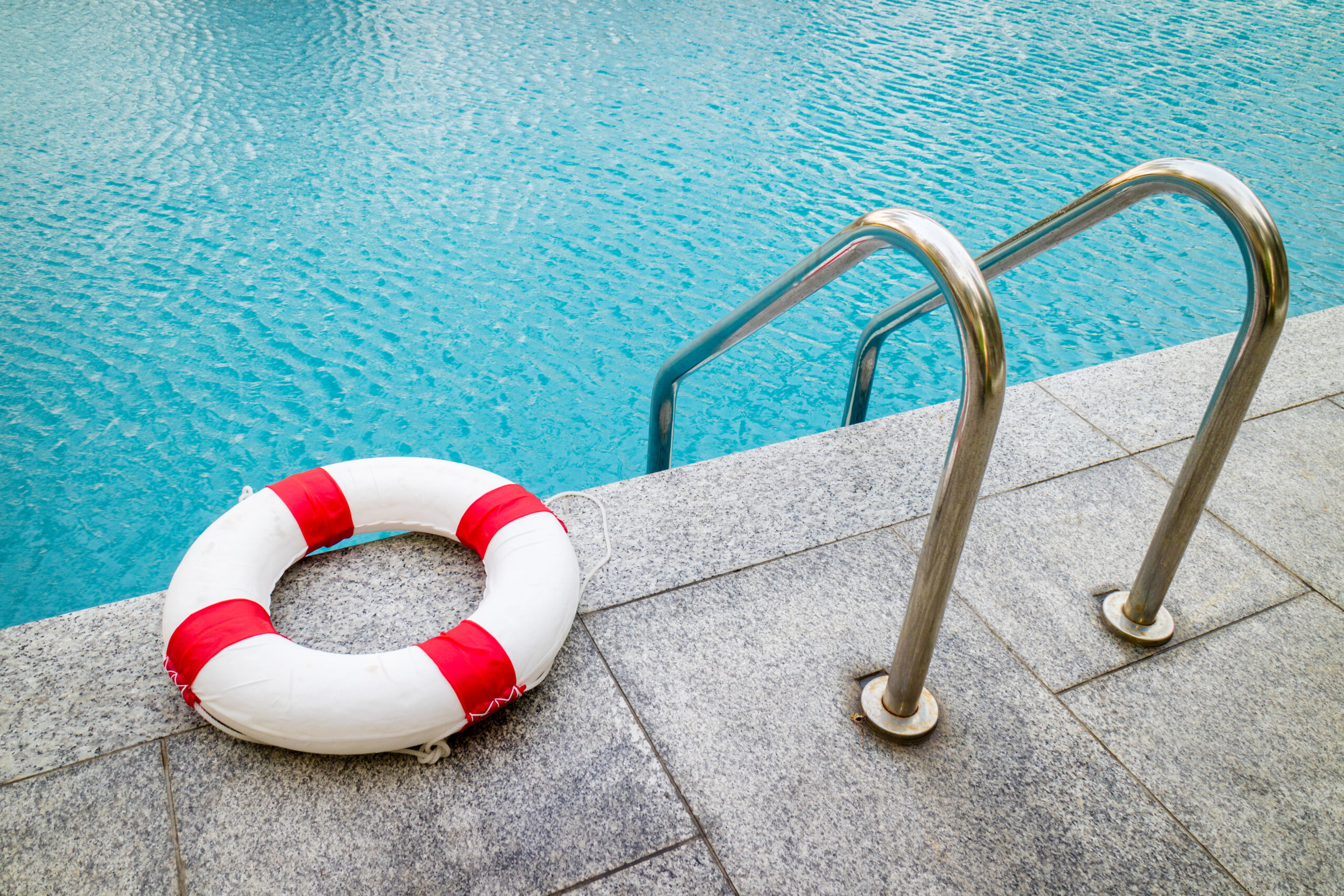
- Posted depth markings, safety equipment (including ring buoys, reaching poles, and first aid supplies), and emergency communication
- Water quality and chemical testing requirements
- Drain cover compliance with the Virginia Graeme Baker Pool and Spa Safety Act
- Specific fencing, gate, and barrier requirements stricter than residential pools
Violations of these regulations; a missing lifeguard, a non-compliant drain cover, an unmarked deep end, an unfenced area, are not just regulatory issues, they are admissible evidence of negligence in a Pennsylvania pool injury lawsuit.
Layered Protection: How to Prevent a Pool Accident This Season
Pool safety experts at the CDC and the U.S. Consumer Product Safety Commission promote a “layered protection” model. No single safety measure is sufficient; instead, multiple barriers must fail before a tragedy occurs. Layered protection means combining all of the following:
- Fences, Gates, and Door Alarms
A four-sided isolation fence- one that separates the pool from the house and the rest of the yard, is the single most effective drowning prevention measure. Studies cited by the CDC suggest four-sided isolation fencing reduces residential pool drowning risk by more than 80% compared to three-sided fencing that uses the house as one of the barriers. If a wall of the house is being used as part of the barrier, every door and operable window providing access to the pool area must be alarmed.
- Constant, Active Adult Supervision
“Watching the kids” while reading, scrolling, talking with another adult, or going inside for a moment is not supervision. The CDC recommends designating a “Water Watcher,” one adult whose only job for a defined period of time is watching the pool, undistracted. The role rotates so no single adult bears the burden alone, and the responsibility is explicit, not assumed.
- Swim Lessons
Formal swimming lessons reduce drowning risk in young children by approximately 88%, according to research published by the American Academy of Pediatrics. Lessons should begin as early as age 1 for children at high risk of water exposure. Lessons do not eliminate drowning risk- layered protection is still required, but they meaningfully reduce it.
- CPR and First Aid Training
In a near-drowning, the difference between full recovery and lifelong brain damage is often measured in minutes. Adults responsible for supervising children near pools should be trained in CPR and basic first aid, including infant and child variations, and should refresh that training regularly.
- Life Jackets for Weak and Non-Swimmers
U.S. Coast Guard-approved life jackets, not water wings or pool toys, are appropriate for non-swimmers and weak swimmers. Pool toys are entertainment, not safety equipment, and their presence sometimes creates a false sense of security.
- Drain Covers and Equipment Maintenance
Pool owners should ensure all drains have compliant anti-entrapment covers and that pumps, lighting, ladders, and decks are inspected and maintained regularly. The Virginia Graeme Baker Pool and Spa Safety Act, named for a young child killed by drain entrapment, sets the federal standard.
- Rules and Restrictions
No running on the pool deck. No diving in shallow water or above-ground pools. No swimming alone. Children should always be with an adult. These rules are simple, but they are routinely ignored, and when they are, injuries follow.
Pennsylvania Premises Liability Law and Pools
The Attractive Nuisance Doctrine
Pennsylvania law recognizes a doctrine called “attractive nuisance,” and swimming pools are the textbook example. Under the Restatement (Second) of Torts § 339, adopted by Pennsylvania courts, a property owner can be liable for injuries to child trespassers when an artificial condition on the property is likely to attract children, the owner knows or should know about it, and reasonable safety precautions were not taken. Even if a child climbed a fence or wandered onto the property without permission, the homeowner can still be liable in a premises liability claim when an inadequately fenced pool draws the child to the danger. This doctrine is the legal foundation for most pool drowning cases involving young children.
Duty of Care for Lawful Visitors
For invited guests at a backyard pool, customers at a hotel pool, or members at a community pool, the duty of care is even higher. Property owners must inspect the premises for hazards, fix or warn of dangerous conditions, and actively maintain safety. Failures of any kind- a broken latch, a missing depth marker, an absent lifeguard, or a slippery deck without slip-resistant surfacing, can support a claim.
Comparative Negligence
Under Pennsylvania’s modified comparative negligence rule at 42 Pa. C.S. § 7102, if an injured adult is partially at fault, recovery is reduced proportionally and barred entirely if the victim is more than 50% at fault. Insurers commonly raise comparative fault arguments such as when the swimmer was intoxicated, the diver dove into known shallow water, or when the parent should have been watching more carefully. Special rules apply when the victim is a young child; very young children typically cannot be assigned legal fault at all, because they lack the capacity to recognize the danger.
Who Can Be Held Liable in a Pennsylvania Pool Accident?
Liability often extends beyond the obvious. Possible defendants include:
- Homeowners: for inadequate fencing, broken gates, missing alarms, or known hazards
- Hotels, motels, and resorts: for failure to comply with public pool regulations under 28 Pa. Code Chapter 18, inadequate lifeguarding, missing signage, or defective equipment
- HOAs and community pools: for failures of supervision, safety policies, and barrier maintenance
- Apartment complexes and landlords: for unsafe conditions in tenant-accessible pool areas
- Pool installation companies: for negligent installation or failure to install required safety features
- Maintenance companies: for negligent maintenance or repair
- Lifeguards and lifeguard employers: for negligent supervision
- Manufacturers: for defective drains, drain covers, pool components, or chemicals Manufacturers
- Day camps, schools, and event organizers: for failure to supervise children at off-site pools
Common Injuries in Pennsylvania Pool Accidents
Pool injuries can be among the most catastrophic in any area of personal injury law. Common categories include traumatic brain injuries from oxygen deprivation in near-drownings or from slip-and-fall impacts on pool decks; spinal cord injuries from diving into shallow water, often resulting in permanent paralysis; broken bones from falls; lacerations and stitches from broken pool components; chemical burns; electrical injuries; and infections from contaminated water. Slip and fall accidents on wet pool decks are among the most common pool injuries treated in emergency rooms during the summer months.
What to Do After a Pennsylvania Pool Accident
If you, your child, or a loved one is injured in a pool accident:
- Get medical attention immediately: Even after a brief submersion incident with no obvious symptoms, get the victim evaluated. “Secondary drowning” and delayed brain injury can develop hours later.
- Call 911 if the situation is serious: An official emergency response creates documentation that becomes valuable evidence.
- Document everything: Photograph the pool, the fence and gate, any alarms (or absence of them), depth markers, the deck condition, and the surrounding area. Note the time and any conditions that contributed.
- Identify witnesses: Get names and contact information from anyone who saw the accident or responded to it.
- Preserve the scene if possible: Do not allow the property owner to repair, replace, or remove the conditions that caused the injury before evidence is preserved.
- Report the incident: If the accident occurred at a hotel, community pool, or commercial facility, request and retain a copy of any incident report.
- Do not give a recorded statement to the property owner’s insurance company: Adjusters call quickly and sound concerned. Their job is to reduce the claim. Refer all calls to your attorney.
- Contact a pool accident attorney promptly: Evidence in pool cases- surveillance footage, fence height measurements, gate operation, lifeguard schedules, maintenance records, disappears or gets “fixed” quickly. The earlier the investigation begins, the stronger the case.
Compensation Available After a Pennsylvania Pool Accident
A successful pool injury claim can recover the full range of damages available in any Pennsylvania personal injury claim:
- Past and future medical expenses, including hospitalization, surgery, rehabilitation, and lifetime care needs
- Lost wages and lost future earning capacity
- Pain and suffering
- Emotional distress and PTSD
- Permanent scarring and disfigurement
- Loss of enjoyment of life and loss of consortium
- In cases involving particularly dangerous or reckless behavior, including known violations, repeated complaints, or deliberate safety failures, punitive damages may apply.
When a pool accident takes a life, surviving family members may pursue a wrongful death claim under Pennsylvania’s Wrongful Death Act, recovering for funeral expenses, lost financial support, and loss of companionship. Pennsylvania law tolls the statute of limitations for minors, meaning a child injured in a pool accident has until their 20th birthday to file (the standard two-year deadline begins running on the 18th birthday). Even with that extended deadline, evidence preservation matters, so, the sooner an attorney is involved, the more effectively the case can be built.
Frequently Asked Questions
Often, yes. Pennsylvania’s attractive nuisance doctrine, derived from Restatement (Second) of Torts § 339, allows a child who trespasses to access an attractive condition like a pool to recover damages if reasonable safety precautions were not in place. The legal question typically turns on whether the homeowner met Pennsylvania’s pool barrier requirements — 48-inch fence, self-closing self-latching gate, no openings larger than 4 inches, and door alarms where the house serves as part of the barrier. Failures of those requirements are powerful evidence of negligence.
Residential pools 24 inches or deeper must be enclosed by a barrier at least 48 inches high (measured on the side facing away from the pool), with no openings large enough to pass a 4-inch sphere, no more than 2 inches of clearance between the bottom of the barrier and the ground, self-closing and self-latching gates with the latch installed at least 54 inches above grade, and door alarms where the house serves as part of the barrier. These requirements come from the International Swimming Pool and Spa Code adopted in Pennsylvania at 34 Pa. Code Chapter 403.
Generally, two years from the date of the injury under 42 Pa. C.S. § 5524. For minor children, the two-year clock does not begin running until the child’s 18th birthday — giving them until their 20th birthday to file. If the pool was on government-owned property (a township pool, state park pool, or public school pool), much shorter notice deadlines may apply, sometimes within six months under the Political Subdivision Tort Claims Act. Do not delay. Evidence fades quickly, and the sooner an attorney is involved, the more effectively the case can be preserved and proven.
Public pools — including hotel pools, HOA pools, community pools, and waterparks — are governed by 28 Pa. Code Chapter 18, with strict standards for fencing, lifeguarding, drain covers, water quality, and safety equipment. These cases often involve corporate defendants with substantial insurance coverage and detailed regulatory records. Violations of Chapter 18 are admissible evidence of negligence and frequently establish liability.
Yes, in most cases. Under Pennsylvania’s modified comparative negligence rule at 42 Pa. C.S. § 7102, your recovery is reduced by your percentage of fault, and barred entirely only if you are more than 50% at fault. Children below a certain age are typically not assigned legal fault because they lack the capacity to appreciate the danger. Insurers raise comparative fault arguments aggressively in pool cases — which is why representation matters.
Nothing up front. We handle every pool accident case on a contingency fee basis — you pay no legal fees unless we recover compensation for you. The initial consultation is always free. We can meet at our office, your home, a hospital, or a rehab facility throughout Lancaster, York, and Chester County.